Financial institutions have invested heavily in cybersecurity over the past decade. Firewalls are more sophisticated, identity management is stronger, and endpoint protection has become standard across enterprise environments. Yet one category of connected technology is still frequently overlooked: AV systems.
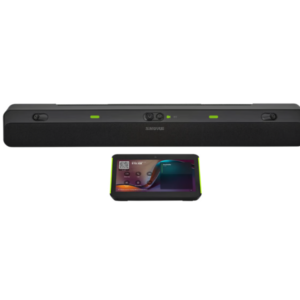
Today’s conference room cameras, room controllers, digital signage players, interactive displays, and video conferencing appliances are no longer standalone pieces of hardware. They are network-connected endpoints that communicate with cloud services, receive firmware updates, and integrate with enterprise collaboration platforms. In other words, they deserve the same level of governance as any other connected device on the network.
For banks, credit unions, and investment firms operating under strict regulatory requirements, treating AV separately from IT is becoming an increasingly risky assumption.
AV Is No Longer Just Meeting Room Technology
Hybrid work, virtual client meetings, and digitally connected branch offices have transformed how financial institutions communicate. Collaboration spaces now rely on technologies like Microsoft Teams Rooms, Zoom Rooms, networked cameras, digital signal processors (DSPs), wireless presentation systems, and room scheduling panels.
Each of these devices has an IP address, runs firmware, connects to enterprise networks, and often communicates with cloud-based services.
That means every AV device expands an organization’s technology footprint.
While cybersecurity teams routinely inventory laptops, servers, and mobile devices, AV systems can sometimes fall outside established endpoint management practices. It’s not because they’re inherently less secure, but because they’re often viewed as facilities equipment rather than enterprise infrastructure.
That distinction is becoming increasingly outdated.
Every Connected Device Deserves Attention
Modern cybersecurity strategies emphasize visibility. Organizations cannot effectively secure assets they don’t know exist.
This principle, reinforced by frameworks such as the National Institute of Standards and Technology (NIST) Cybersecurity Framework 2.0, applies equally to AV technology.
When AV endpoints are excluded from routine governance, common operational issues begin to emerge:
- Firmware updates are delayed or overlooked.
- Default administrative credentials remain unchanged.
- Unsupported devices stay connected long after vendor support ends.
- Equipment purchased outside standard IT processes creates “shadow AV.”
- Device inventories become incomplete or outdated.
None of these challenges are unique to AV. They mirror the same lifecycle management concerns IT departments already address across other enterprise technologies.
The difference is that AV often exists in an ownership gap between facilities, IT, and cybersecurity teams.
Compliance Doesn’t Stop at the Data Center
Financial institutions operate in one of the world’s most heavily regulated industries. Guidance from organizations such as the Federal Financial Institutions Examination Council (FFIEC) consistently emphasizes asset management, access controls, software maintenance, and ongoing risk assessment.
Although these frameworks don’t specifically call out AV equipment, they focus on something broader: every connected technology that could affect the organization’s security posture.
If a conferencing appliance authenticates users, it belongs in governance discussions.
If a room controller connects to the corporate network, it should be included in asset inventories.
If digital signage players receive remote updates, they should follow documented lifecycle management practices.
Regulators aren’t concerned with whether a device is labeled “AV” or “IT.” They’re concerned with whether organizations understand and manage the risks associated with connected systems.
Security and User Experience Can Work Together
Some organizations worry that stronger security controls create a more complicated meeting experience. In reality, standardization often improves both.
When collaboration platforms are consistently deployed, centrally managed, and maintained through documented processes, employees experience fewer technical issues while IT teams gain greater visibility into system health.
That consistency delivers benefits across multiple departments:
- Employees spend less time troubleshooting meeting rooms.
- IT teams simplify firmware management and monitoring.
- Security teams gain better endpoint visibility.
- Compliance teams have clearer documentation for audits.
Rather than competing priorities, security and usability frequently reinforce one another when systems are designed with long-term management in mind.
For financial institutions, where confidential conversations occur daily between advisors, executives, and customers, dependable collaboration technology is as much a business requirement as it is a technical one.
AV Is a Shared Responsibility
One of the biggest challenges isn’t technology, it’s ownership.
Facilities teams typically manage meeting spaces.
IT departments oversee enterprise infrastructure.
Cybersecurity teams establish security policies.
Compliance officers ensure governance requirements are met.
Modern AV sits at the intersection of all four.
Questions like who manages firmware updates, who approves device purchases, or who retires unsupported equipment don’t always have clear answers. Without defined ownership, devices can gradually drift outside standard operational processes.
Financial institutions increasingly benefit from treating AV as shared enterprise infrastructure rather than assigning responsibility to a single department.
When facilities, IT, security, and compliance collaborate throughout the technology lifecycle, from procurement to retirement, organizations gain stronger visibility, greater consistency, and fewer surprises during audits.
Questions Every Financial Institution Should Ask
As collaboration technology becomes more integrated into enterprise operations, banking leaders should periodically evaluate their AV environment by asking:
- Do we maintain a complete inventory of network-connected AV devices?
- Are firmware updates included in our patch management process?
- Who owns the security and lifecycle management of AV systems?
- Can IT monitor collaboration devices remotely?
- Are AV endpoints included in vulnerability assessments where appropriate?
- Do our collaboration platforms follow the same security standards as other enterprise technologies?
These aren’t simply technical questions, they’re governance questions.
Treat AV Like Enterprise Infrastructure
The convergence of AV and IT is no longer a future trend; it’s today’s reality. Every connected display, conferencing appliance, room controller, and networked camera contributes to the organization’s overall technology environment.
Financial institutions that recognize this shift are better positioned to reduce operational risk while supporting secure collaboration across branches, executive boardrooms, and customer meeting spaces.
That doesn’t necessarily require reinventing existing security programs. Instead, it means extending familiar IT principles, asset visibility, standardized deployments, lifecycle management, centralized monitoring, and documented governance, to technologies that have traditionally been managed separately.
Experienced AV integration partners can play an important role in that process by helping organizations design environments that align with both enterprise IT strategies and the operational realities of regulated industries.
Ultimately, the strongest cybersecurity strategies begin with visibility. Financial institutions already apply that philosophy to servers, laptops, and cloud platforms. As AV systems continue evolving into software-driven, IP-connected endpoints, they deserve the same attention.
The conference room camera may not be the first device discussed during a cybersecurity review, but in today’s banking environment, it has become part of the enterprise network, and it should be managed accordingly.
- AVNation Staff

- AVNation Staff

- AVNation Staff

- AVNation Staff