Sennheiser staff spent the summer testing the new Spectera SKM handheld on some of the biggest tours in the business. Hundreds of broadcasters and touring engineers ran it for a week or two at a time, staff said. Prototype units were still scarce back then.
The Spectera SKM handheld transmitter started shipping Sept. 10, completing the core Spectera wireless platform, according to Sennheiser. The Sennheiser Group is showing it at IBC2026, Hall 8, Booth D50, through Sept. 14. With body packs and handhelds both shipping, the platform covers microphones, in-ear monitoring, and remote control in one system.
Built and tested on tour
Staff said the handheld went through a pioneer program that ran for about six months before launch. Hundreds of touring broadcasters and engineers tested it on some of the biggest international tours in the business. Each group ran the microphone for a week or two, staff said. Sennheiser only had a limited number of early prototypes at the time. Sennheiser expanded the program over the summer as more units became available.
The clearest proof point came at the Eurovision Song Contest 2026 in Vienna. Staff said Spectera, including early manufacturing samples of the SKM handheld, ran at its largest deployment to date there. Multiple base stations handled wireless microphones, in-ear monitoring, and control for the entire show.
Why does it sound better?
Staff said the most common feedback from testers is simple: the new microphone sounds better than Sennheiser’s older wireless formats. That’s a strange claim, staff admitted, since the SKM often uses the same capsule and coating as its predecessors. Staff said they don’t have the full explanation. They pointed to newer circuitry and a refined transmission scheme. There’s also a digital link between the base station and earpiece that used to be analog.
In a statement, Sennheiser Product Manager Bernd Neubauer said Spectera addresses common frustrations with wireless audio systems. Sennheiser “will continue evolving the ecosystem based on industry feedback, needs and ideas,” Neubauer said. Sennheiser plans new software features, hardware, and services over time.
One platform, now complete
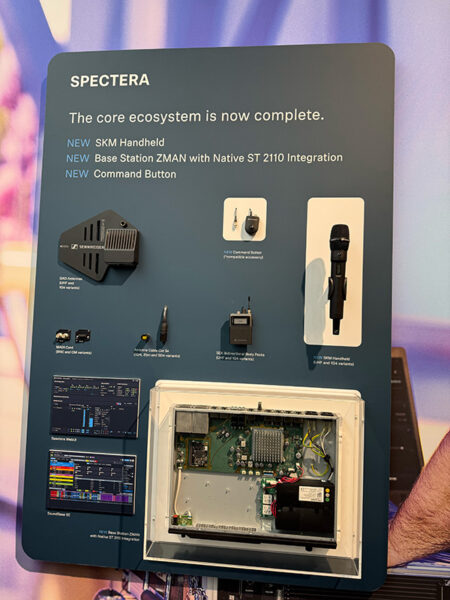
The SKM handheld completes what Sennheiser calls the core Spectera platform, joining the SEK body pack that shipped earlier. Both share the same BA 70 rechargeable battery and connect to the same base stations. The handheld comes in UHF and 1.4 GHz variants, with latency as low as 1.0 millisecond. A single RF channel supports up to 128 devices and audio links.
Battery life runs more than six hours in live mode, and the handheld weighs about 196 grams without its battery. Encryption is AES-256, and Sennheiser built the housing from metal rather than plastic. An OLED display shows status information on the device itself.
A button that can do almost anything
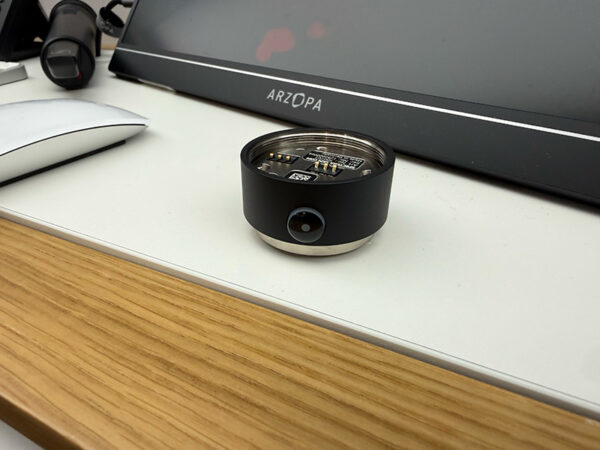
Sennheiser is also rolling out Spectera Command, an accessory that gives performers direct control over their own audio routing. A Command Button attaches between the transmitter body and the microphone capsule, staff said. A Command Ring for the SKM handheld arrives in October. Engineers can configure the button as a momentary push or a latched switch.
A common use, staff said, is letting a singer mute the house PA and talk directly to monitor engineers. That works without a separate communication channel. Staff said the button can trigger almost anything wired into a production’s network, not just audio. Only half joking, staff floated a weather host using the same button to swap a background graphic. A stage show could just as easily trigger fireworks with it.
Filling out the booth
Sennheiser is showing more than just the handheld at IBC2026. The Spectera Base Station ZMAN adds native ST 2110-30 audio integration through a Merging Technologies module. It’s aimed at broadcast engineers working in AES67 environments. It’s expected to ship in October.
Neumann is also debuting two new capsule heads for Sennheiser’s wireless systems, the KK 104 A and KK 105 A. Both succeed Neumann’s existing KK 204 and KK 205 capsules, with a slimmer shape and better suppression of handling noise.
SoundBase, a Sennheiser partner, is showing RF planning software that now fully supports Spectera and its Command accessories. Its Remote View tool lets a production team share live monitoring data without adding network traffic. Elsewhere on the stand, Sennheiser walks visitors through a full signal chain. MKH microphones and EW-DX wireless feed into a Merging Technologies HAPI interface. Neumann monitors and Sennheiser’s HD 480 PRO and HD 490 PRO headphones handle monitoring. Ovation playout and the Pyramix workstation finish the chain.
What it means for you
For AV and broadcast buyers, Spectera’s pitch is now a complete one. The same wireless platform scales from a single handheld mic to a Eurovision-sized broadcast. Whether the audio quality gains hold up under scrutiny is a harder question. Sennheiser itself admits it doesn’t have a full technical explanation. For now, the company is leaning on testimonials from touring engineers who prefer it side by side.
See all AVNation’s IBC 2026 coverage.

Tim Albright is the founder of AVNation and is the driving force behind the AVNation network. He carries the InfoComm CTS, a B.S. from Greenville College and is pursuing an M.S. in Mass Communications from Southern Illinois University at Edwardsville. When not steering the AVNation ship, Tim has spent his career designing systems for churches both large and small, Fortune 500 companies, and education facilities.
- Tim Albright

- Tim Albright

- Tim Albright

- Tim Albright