Clear-Com carried its cellular intercom system across the Atlantic this week. The company confirmed wider availability at IBC 2026 in Amsterdam. Its booth at Stand 10.D29 spotlights FreeSpeak Cell, a wireless beltpack system. The system relies on LTE and 5G networks instead of dedicated RF spectrum.
Clear-Com launched FreeSpeak Cell in North America earlier this year. Now the company says it is shipping across Europe, the Middle East and Africa. A new license clears the way for European sales.
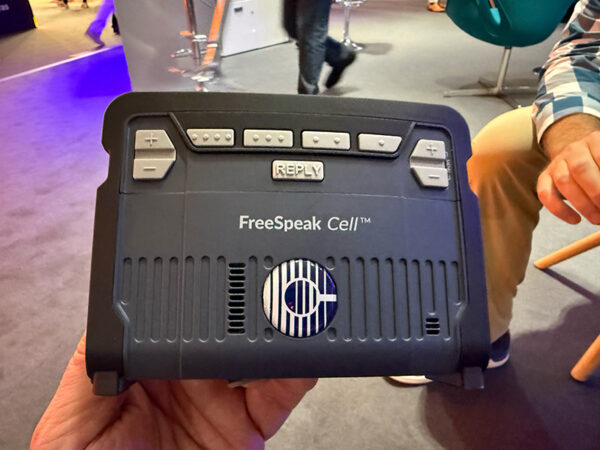
A Clear-Com executive demonstrated the system on the show floor. The executive explained why cellular infrastructure changes the math for large productions. Traditional wireless intercom decks require broadcasters to install antennas around a venue. Crews then manage a limited slice of RF spectrum among competing teams.
That setup works fine for small crews. But large events create real headaches, the executive said. Broadcasters, coaches and referees often compete for the same spectrum during a single match. Big campuses and large racetracks make the problem worse, because antenna coverage struggles to reach every corner.
FreeSpeak Cell sidesteps that competition entirely. Each beltpack carries its own cellular radio and a SIM card. So it connects directly to a public or private cellular network, not a venue-based antenna array. According to Clear-Com, the system scales to hundreds of units. A typical deck-based system tops out around 20 to 30 beltpacks before RF management becomes a burden.
Because coverage comes from cellular infrastructure, not fixed antennas, crews can move beltpacks anywhere a carrier reaches. That flexibility matters for sports coverage across sprawling venues. It also helps productions that span multiple sites in a single city.
Clear-Com has already tested FreeSpeak Cell at major sporting events. Those include the Super Bowl, the PGA Championship and the XFL. Broadcasters including CBS Sports have field-trialed the beltpacks too, according to the executive. Freelance crews spotted the units during early testing and asked questions on-site. From there, additional field trials followed quickly.
One deployment stood out. TV Globo used FreeSpeak Cell to cover Carnival in Brazil. Huge crowds packed local cellular networks for a week straight. Reporters carried the beltpacks alongside separate field transmission gear. As a result, they worked without staying tied to a satellite truck. The test held up even though regional cellular infrastructure faced heavy strain, the executive said.
Cost tracks closely with a traditional deck-based system, according to Clear-Com. Carrier data plans also drop sharply at volume. The executive said monthly per-unit cellular plans fall from roughly $30 to $40. Once a customer buys more than 10 lines, that price drops to $10 to $15.
For IT and AV decision-makers, that pricing detail carries real procurement weight. Buyers often weigh FreeSpeak Cell against a deck-based rival, such as Riedel’s Bolero. Therefore, they should factor recurring carrier costs into total cost of ownership, not just the upfront hardware price.
FreeSpeak Cell supports both public carrier networks and private cellular deployments. That includes the CBRS band many U.S. venues already use for other operational systems. European venues are building out private 5G networks. They should ask Clear-Com how that option applies locally, since licensing rules vary by country.
The IBC announcement centers on that European expansion. Clear-Com says it now holds the license needed to sell FreeSpeak Cell across the region. Formal carrier certification should follow by the end of the year. Certification isn’t required to sell or use the system. However, it gives customers direct carrier support once it lands.
FreeSpeak Cell currently integrates with Clear-Com’s Eclipse HX digital matrix platform. The company plans to add support for its Arcadia Central Station later this year. Support for its cloud-based Gen-IC platform is also planned for later this year. Customers on those platforms may want to wait for that integration before buying.
Clear-Com isn’t limiting its IBC presence to FreeSpeak Cell. The company is also showing Avalon IP Station, a compact 1RU platform. Avalon is built for IP-based broadcast operations. It supports Clear-Com’s FreeSpeak wireless systems, its HelixNet digital partyline and its V-Series keypanels. Together, that gives broadcasters a single frame for multiple intercom types.
Eclipse HX picks up updates too. The system now runs EHX v15 software. That update adds Clear-Com’s Access Resource Configuration technology. The technology lets broadcasters manage and scale intercom ports and resources without installing extra hardware. That detail matters for facilities juggling tight budgets and shifting schedules.
Clear-Com is also showing updates to its Arcadia Central Station at the booth. Together, the lineup builds toward one theme. Broadcasters get fewer trucks, less cabling and less on-site RF coordination.
For IT and AV decision-makers weighing an intercom refresh, the FreeSpeak Cell expansion sends a clear signal. Cellular-based communications no longer live only in trade show demos. Instead, they now back some of the largest live broadcasts in the world. And they are shipping in more markets than before.
To see all AVNation’s IBC 2026 coverage go here.

Tim Albright is the founder of AVNation and is the driving force behind the AVNation network. He carries the InfoComm CTS, a B.S. from Greenville College and is pursuing an M.S. in Mass Communications from Southern Illinois University at Edwardsville. When not steering the AVNation ship, Tim has spent his career designing systems for churches both large and small, Fortune 500 companies, and education facilities.
- Tim Albright
- Tim Albright

- Tim Albright
- Tim Albright