
Category: Article

  • E-Paper Advantage

    E-Paper Advantage

    About 15 years ago, I bought my first device with an electronic paper (e-paper) display – the third-generation Kindle e-reader (also known as the Amazon Kindle Keyboard). I was immediately impressed by the readability of its 6-inch monochrome screen, especially when viewed under bright room lighting or even direct sunlight – a scenario that a liquid crystal display (LCD) of the era would struggle with. I was also impressed by how efficient this display device was, able to last several weeks on a single charge. Today, e-paper refers to several distinct display technologies that mimic the characteristics of a traditionally printed page while offering the advantages of a pixel-based digital device.

    Amazon Kindle Keyboard - Image credit: Amazon
    Amazon Kindle Keyboard – Image credit: Amazon

    The exceptional energy efficiency of e-paper displays comes from their ability to update only when changes are needed – think of it as an organization of lazy pixels. Once an image finishes rendering on an e-paper display, little to no additional power is required to maintain its state. Compared to something like an LCD television, which constantly refreshes every pixel 50-60 times a second (or much more frequently) and uses a bright LED backlight array for illumination, the pixels of an e-paper display are reflective, utilizing ambient light sources to produce a visible image. For nighttime or darkroom viewing, manufacturers augment their e-paper displays with LEDs or electroluminescent materials.
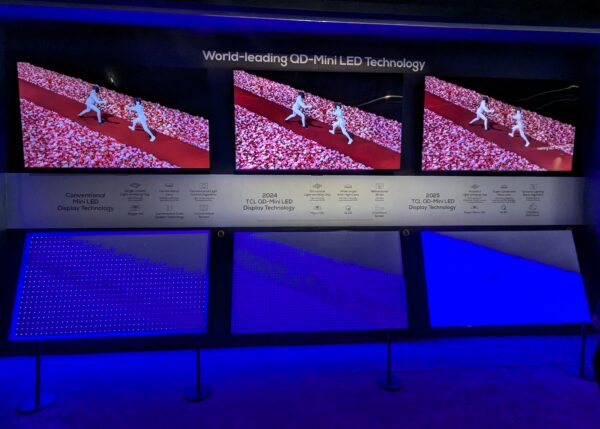
    Blue LED LCD backlight demonstration - Image credit: Robert Heron
    Blue LED LCD backlight demonstration – Image credit: Robert Heron

    Electronic Ink

    One of the most popular types of e-paper display technologies involves particles suspended in a fluid-filled pixel that move when an electric field is applied, a process called electrophoresis. Nick Sheridon developed the first electrophoretic display (EPD) in the 1970s at Xerox PARC. It used half-black, half-white plastic microspheres, each side carrying an opposite electric charge (a dipole), suspended in oil that allowed them to rotate in response to the polarity of the applied voltage. This interaction caused each pixel in the prototype EDP to appear brighter or darker as the particles aligned with the pixel’s polarity. The oil’s viscosity helped maintain the spheres’ orientation even after the voltage ceased, significantly improving efficiency when displaying static images.
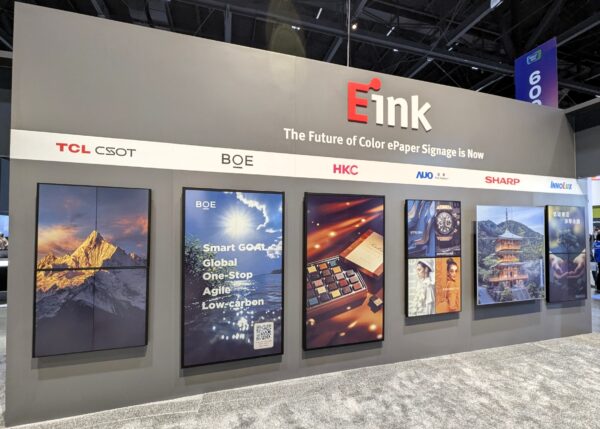
    E Ink color e-paper signage demonstration - Image credit: Robert Heron
    E Ink color e-paper signage demonstration – Image credit: Robert Heron

    It’s impossible to talk about e-paper without mentioning E Ink. This company traces its origin to pioneering work on EPD technology at the MIT Media Lab in the 1990s. E Ink’s initial expertise included the development of e-paper “ink” technologies that featured encapsulated charged color particles suspended in a clear fluid that better resisted degradation, thereby extending the display’s usable lifespan. E Ink’s range of e-paper products now includes the use of a single particle color on up to four particle systems that offer an extensive color palette that can reproduce 10s of thousands of hues.
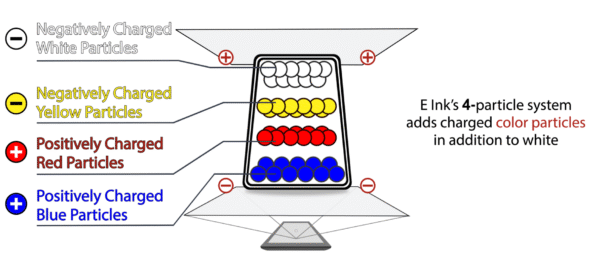
    E Ink color particle system - Image credit: E Ink
    E Ink color particle system – Image credit: E Ink

    Acquisitions, mergers, and partnerships have resulted in E Ink’s technological and product domination in the EPD space. E Ink’s merger with a thin-film transistor (TFT) LCD manufacturer in 2008 helped scale production and drive technical innovations, just as the company’s e-paper displays were gaining significant recognition in products like the aforementioned Amazon Kindle – all Kindle devices manufactured to date have featured E Ink displays. In 2012, E Ink acquired a rival EPD company, SiPix, that specialized in a more structured system for containing encapsulated color particles that could offer improved image sharpness. The company’s latest color e-paper technology, Spectra 6, has enabled screen sizes up to 75 inches and is featured in products from a wide variety of display manufacturers, including BOE, LG, Samsung, Sharp, TCL, and many others.
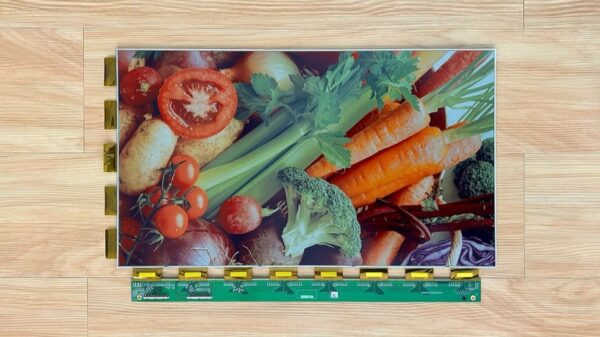
    E Ink Spectra 6 display module - Image credit: E Ink
    E Ink Spectra 6 display module – Image credit: E Ink

    Memory LCD

    A couple of years after my first EPD product experience, I was fortunate to acquire the first edition of the Pebble smartwatch, which featured another e-paper technology still in use today, memory-in-pixel LCD (memory LCD). Memory LCD is similar in overall function to a traditional LCD used in laptops or TVs, except that each pixel features an embedded memory circuit that retains information about the pixel state, requiring very little power to maintain a static image. My Pebble watch’s monochrome memory LCD, manufactured by Sharp, offered excellent readability even in direct sunlight, and it incorporated an efficient three-LED edge-lit backlighting system for viewing in dim to dark environments.

    Pebble smartwatch - Image credit: Robert Heron
    Pebble smartwatch – Image credit: Robert Heron

    Sharp’s memory LCD technology went on to power the follow-up Pebble Time smartwatch, introduced in 2015, that marked the wearable’s first color-capable display (64-color palette) and faster refresh rates. Today, I’m pretty impressed with the numerous features of a wearable like the Garmin FĒNIX 8 solar-charging smartwatch, which features Sharp’s latest iteration of memory-in-pixel color display technology.

    Garmin FĒNIX 8 smartwatch - Image credit: Garmin
    Garmin FĒNIX 8 smartwatch – Image credit: Garmin

    Reflective LCD

    Another e-paper variant based on traditional LCD technology is reflective LCD. Reflective LCDs do away with the LED backlight array and replace it with a reflective layer that makes use of ambient light for illumination. Companies offering display panels based on reflective LCD technology include AU Optronics (AUO), Sharp, and Japan Display Inc. (JDI).

    Transmissive vs Reflective LCD (right) - Image credit: Sharp
    Transmissive vs Reflective LCD (right) – Image credit: Sharp

    Compared to EPD displays, which can take several seconds to complete an update, reflective LCD designs are more responsive with a faster refresh rate of about 30 Hz, making them better able to display motion video compared to the relatively sluggish pixels of an EPD. However, that improved motion performance comes at the cost of increased power usage, and the LCD structure isn’t compatible with being incorporated into flexible films compared to other e-paper display types.

    Electrochromic e-paper

    Electrochromic-based e-paper displays take advantage of materials that can change color or opacity in response to an applied charge. The Canadian company Ynvisible has developed a water-based electrochromic ink that can be applied at scale using traditional printing methods and packaged into ready-to-integrate display modules. The company has optimized its e-paper designs for use in digital signage, indicators, and labels.

    Solar-powered bus stop schedule - Image credit: Ynvisible
    Solar-powered bus stop schedule – Image credit: Ynvisible

    Ynvisible is quick to highlight the exceptional daylight readability and thermal stability of its products. When paired with protective UV films, Ynvisible’s e-paper displays are well-suited for outdoor applications, including below-freezing temperatures that can cause other e-paper technologies to take much longer to update or stop working altogether. Ynvisible’s electrochromic ink also boasts very low average power consumption, measured in a few microwatts per square centimeter of material needed to affect hundreds of segment-changing states. One of the efficiency demonstrations of Ynvisible e-paper indicators shows that a lemon battery can power it.

    Lemon-powered e-paper indicator - Image credit: Ynvisible
    Lemon-powered e-paper indicator – Image credit: Ynvisible

    Efficient with Limitations

    The diverse world of e-paper technologies is a testament to the ingenuity of scientists and engineers who are in search of effective display technologies optimized for low-power applications. The evolution of e-paper, particularly EPD-type displays, will likely never replace a television screen or signage application that calls for dazzlingly bright and saturated imagery that includes fluid video presentations, and that’s OK, as there are other mature display technologies better suited for that application.

    reMarkable 2 e-paper writing tablet - Image credit: reMarkable
    reMarkable 2 e-paper writing tablet – Image credit: reMarkable

    However, one new trick for the EPD e-paper devices we carry around with us is the enhancement of touch capabilities to include the use of electronic pens, with an experience closely approximating the feel of applying a pencil to paper. Companies like Boox, reMarkable, Supernote, and (of course) Amazon are producing compelling (and energy-efficient) e-notebook products with up to 300 PPI displays aimed at creativity, collaboration, and reading.
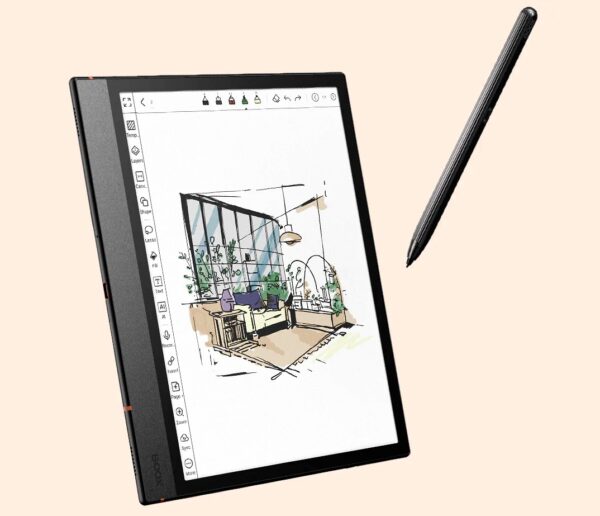
    Boox Note Air4 C - Image credit: Boox
    Boox Note Air4 C – Image credit: Boox

    E-paper technology will always have a place for efficiently powered indicators and signage, and some of these display technologies will continue to prove themselves as the best option for wearables or devices we carry with us.

  • AV Talent Recruitment

    AV Talent Recruitment

    After nearly 30 years in the AV industry, I’ve seen huge transformation. We’ve evolved from being a niche support function to delivering mission-critical systems for live events, global and corporate communications, and immersive experiences. The technology has matured into mainstream, the projects have matured into essential, but I’m concerned that, as it relates to AV talent recruitment and development, many of the employers have not matured at all.

    What Talent Shortage

    Let’s talk about this so-called “talent shortage” in AV. It’s become the industry’s scapegoat for understaffed teams, missed opportunities, skills deficiency, and an overall lack of growth. But here’s the truth: there’s no shortage of talented people. There’s a shortage of employers willing to invest in the development of talented people.

    In my role as a mentor with RISE AV, I’ve met so many driven, capable, and passionate young people. They’re energetic. They’re curious. They’re adaptable, full of energy and ideas. They want to learn. This is EXACTLY the mindset we should be looking for, but instead of developing them, we’re sidelining them because they don’t tick every box on a job spec or haven’t already done the job for 5 years. When the industry holds out for a “ready-made” candidate, we lose potential to RISE the tide, every single day.

    AV Talent Recruitment

    Let me be a little British (blunt): the AV industry is not suffering from a talent crisis. It’s suffering from a development crisis, and we’re the ones responsible. We’ve somehow created a culture where we wait for the “perfect candidate” to walk through the door, fully trained, fully experienced, and ready to go and then complain that they don’t exist. Meanwhile, talented early-career professionals (many from a post COVID era where learning opportunities were limited) are walking away, frustrated and ignored.

    Where are the apprenticeships? Where are the entry-level pathways? Where is the hands-on mentoring that combined with vendor training, once was the only method new employees got grounding / training in AV? Where is true AV talent recruitment and development?

    Mentor Means Investment

    We love innovation in this industry, but innovation doesn’t happen without investment. Stop waiting for the perfect hire. Start building the perfect team. You can teach someone how to run a system or set up a show. You can’t teach someone to be motivated, to care, or to want to grow. But those people are out there — I’ve met them. And they’re ready.

    So, here’s the AV talent recruitment challenge: If you’re not willing to invest in developing people, you don’t get to complain about the talent pipeline. Grow your own. Mentor them. Train them. And watch what happens.

  • The Netflix House Immersive AV Experience

    The Netflix House Immersive AV Experience

    Netflix is taking its most iconic stories off the screen and into physical space. The online streamer is unleashing a wave of immersive AV experiences that blend entertainment, technology, and interactivity. Launching in late 2025, the first two Netflix House locations are landing at Dallas’ Galleria and Philadelphia’s King of Prussia. These new spaces will each span over 100,000 square feet of themed entertainment, interactive sets, and AV-rich environments built for long-term audience engagement.

    With attractions based on franchises like Stranger Things, Squid Game, and Wednesday, Netflix is setting a new standard for location-based entertainment. Behind the thrill and theatrics lies a sophisticated network of audiovisual systems that’s designed for dynamic storytelling and future-proof adaptability.

    Projection Mapping and Immersive Set Design

    Netflix House contestants
    Netflix House contestants. All photos courtesy of Netflix.

    Central to the Netflix House concept are video systems that deliver immersive AV experiences through a blend of 4K/8K LED walls and projection mapping. Visitors entering the Upside Down or the glass bridge of Squid Game will encounter high-contrast LED panels with HDR support. Ultra-short throw and laser projection systems add dimensionality to set pieces and floors. Projection overlays, combined with ambient haze and UV lighting, create spatial illusion and depth beyond the physical stagecraft.

    This video backbone enables scenes to shift dynamically, supporting both immersive storytelling and modular content updates, a must for a venue built on a rotating slate of shows.

    No immersive environment is complete without precise, enveloping sound. Netflix House venues are expected to deploy object-based spatial audio systems. Beamforming speaker arrays embedded in ceilings or walls allow precise placement of sound elements. Think Demogorgons growling overhead, eerie forest ambiance, or countdowns in game zones.

    Zone-based DSP control  allows for granular scene control and seamless audio transitions tied to timecode or guest movement.

    Tracking Immersive AV Experience

    Netflix House Squid Games
    Netflix House Squid Games. All images are provided by Netflix.

    The more interactive elements such as Squid Game: Survive the Trials or Stranger Things: Escape the Dark rely on motion tracking systems and wearable sensors to heighten the sense of agency. This includes IR-based camera arrays, LiDAR scanners, and stereo-vision systems tracking guest movement in real-time.

    At the heart of Netflix House’s AV deployment is a centralized show control system. Show control servers manage the tight integration between lighting, video, audio, and sensors.

    AV over IP (AVoIP) systems running over 10GbE+ infrastructure enable scalable distribution across large, multi-room venues. Real-time synchronization, facilitated by Precision Time Protocol (PTP), ensures that immersive effects remain perfectly timed.

    Control surfaces and automation frameworks coordinate scenes and allow operators to reconfigure content zones daily.

    VR and Gamified Experiences

    Philadelphia’s Netflix House will include Netflix Virtuals, a VR-driven attraction likely powered by Sandbox VR. In these spaces, immersive AV extends into the headset delivering synchronized video, spatial audio, and haptic feedback.

    Gamified mini-golf (e.g., Philadelphia’s “Top 9”) features sensor-equipped putting surfaces with projection overlays, blending physical play and digital feedback. This is a growing subset of immersive AV experiences in experiential retail.

    Future-Ready Design and Operational Resilience

    Netflix House is engineered to evolve. AV systems are modular and IP-based, allowing for seasonal content swaps without full hardware overhauls. This agility is crucial for a streaming giant accustomed to fast content cycles.

    Behind the scenes, AV and IT teams will monitor the system using network diagnostic tools and CMS integration for remote asset management. Nighttime update windows allow Netflix to roll out new effects, audio, and scenes with minimal operational impact.

    Ready for the Immersive AV Experience

    Netflix House overview
    Netflix House Overview. All photos courtesy of Netflix.

    Netflix House is more than a themed experience. It’s a fully realized case study in immersive AV experiences at scale. From beamforming audio and motion-triggered interactivity to massive LED installations and converged IP infrastructure, it demonstrates how AV technology can serve as the backbone of entertainment innovation.

    It offers a roadmap for building flexible, content-driven venues that merge storytelling with cutting-edge audiovisual engineering. And for fans, it’s the promise of stepping into the worlds they love powered by the technology they never see.

  • AV Integration Best Practices Every Tech Manager Should Know

    AV Integration Best Practices Every Tech Manager Should Know

    In the world of AV integration, one mistake can cost more than just time. Mistakes cost money, trust, performance, and long-term reliability. That’s why AV integration best practices start with knowing who you’re hiring. 

    On a recent AVWeek, the panel tackled the all-too-familiar issue of “trunk slammers”. These are unlicensed, underqualified individuals who promise rock-bottom prices and lightning-fast installs, often working out of the trunk of their car. But at what cost? 

    Examples of Bad AV

    “When you see something hanging from one cable in the ceiling, held up by a prayer, that was done by someone with a piece of equipment and a dream,” said Steph Beckett of AV Buyers Club. “They’re gone the second the job is done. No support, no warranty, no follow-up.” 

    Trunk slammers thrive on being cheap and fast. But best practices in AV integration require more than a low bid. They demand qualifications, insurance, references, and above all, accountability. 

    Beyond the Bottom Line 

    “You need to review the proposal without looking at the cost first,” advised Bren Walker of Kirkegaard. “If they don’t have insurance, references, or qualifications, you need to keep moving. And if you really need to save money, challenge your reputable vendors to sharpen their bids instead.” 

    From the perspective of systems integrators and the broader commercial AV industry, credentials and dealer partnerships go hand-in-hand with professionalism. 

    “There’s a big difference between ‘I can get the gear’ and ‘I’m certified to install and support it,’” said Commercial Integrator’s Amala Reddie. “Trunk slammers might be able to buy gear off Amazon, but that doesn’t mean it’s the right equipment for your needs. Integrators bring expertise and trusted partnerships that go beyond the hardware.” 

    AV Best Practices in the Real World 

    The appeal of low-cost AV installs is understandable, especially in budget-conscious areas like higher education or house of worship. But the long-term cost of cutting corners can outweigh any short-term savings. Those costs include downtime, replacements, lack of support, or counterfeit gear. 

    That’s why AV integration best practices always come back to diligence: 

    • Ask for certifications and verify them. 
    • Request recent references and speak to past clients. 
    • Require insurance documentation with your organization named. 
    • Prioritize total cost of ownership, not just initial price. 

    Because when it comes to professional AV systems, the job isn’t finished at installation. It has  only just begun. 

    You can listen to the full episode of AVWeek here. 

  • Top 10 Strategies for Bulletproof Data Security in Financial Institutions

    Top 10 Strategies for Bulletproof Data Security in Financial Institutions

    In today’s digitally driven economy, data is the currency, and for financial institutions, it’s the most valuable asset under threat. With cyberattacks growing in complexity and frequency, the need for fortified data security protocols has never been more pressing. From encrypted AV communication platforms to real-time threat detection systems, the convergence of IT and AV in the financial world is reshaping how institutions protect sensitive information.

    This is where the Audio Visual (AV) and IT industries are stepping into high gear. Whether it’s a secure collaboration suite in a boardroom or a fully integrated video conferencing solution that complies with FINRA and SEC guidelines, safeguarding data across every endpoint is mission-critical.

    Here are the Top 10 Strategies for Bulletproof Data Security in today’s financial sector.

    1. Adopt Zero Trust Architecture (ZTA)

    Zero Trust is not just a buzzword, it’s the backbone of modern data defense. It operates under the principle of “never trust, always verify.” Every user, device, and application is treated as a potential threat, requiring continuous authentication.

    For AV integrators and IT managers, this means every touchpoint, from video conferencing endpoints to digital signage systems, must be authenticated and monitored in real-time. Implementing ZTA ensures that even if a breach occurs, lateral movement within the network is restricted.

    2. Implement End-to-End Encryption for AV Communications

    Secure communication tools are no longer optional; they are regulatory imperatives. Financial institutions must ensure that all internal and client-facing communications are end-to-end encrypted (E2EE).

    Modern AV platforms with E2EE not only secure data in transit but also align with compliance frameworks like General Data Protection Regulation (GDPR), Sarbanes-Oxley compliance (SOX), and Payment Card Industry Data Security Standard (PCI DSS). Look for AV solutions that use AES-256 encryption and support SRTP for real-time media transmission.

    3. Invest in Secure AV Hardware

    A secure AV ecosystem begins with secure hardware. Devices such as cameras, microphones, and DSPs must be sourced from trusted vendors and come equipped with built-in firmware-level security.

    Compliance officers and IT directors must demand secure boot processes, tamper-resistant chipsets, and remote firmware validation capabilities in all AV hardware. This significantly mitigates the risk of supply chain attacks.

    4. Deploy Network Segmentation

    Segmenting AV and IT networks is a crucial defense strategy. Financial institutions must isolate critical systems from general-purpose networks to reduce the attack surface.

    By creating separate VLANs for AV traffic, sensitive data transmission, such as boardroom meetings or investor calls, can be shielded from unauthorized access. This also aligns with NIST cybersecurity guidelines.

    5. Harden Unified Communications (UC) Platforms

    AV-integrated UC platforms like Microsoft Teams, Zoom, or Webex are ripe targets for threat actors. These platforms must be hardened with multi-factor authentication (MFA), secure API integrations, and real-time usage analytics.

    Furthermore, IT administrators should routinely audit access logs and configure conditional access policies to detect and block suspicious login attempts.

    6. Conduct Regular Penetration Testing on AV Systems

    Don’t just assume your AV system is secure, test it. Routine penetration testing should be performed not only on traditional IT systems but also on AV environments.

    This includes testing video endpoints, control systems, and streaming devices for potential vulnerabilities. Financial institutions should partner with cybersecurity firms specializing in AV infrastructure for comprehensive testing.

    7. Centralize Device Management with AV-over-IP Monitoring

    AV-over-IP is rapidly becoming the new standard in financial services, but with great flexibility comes great responsibility. Centralized device management platforms allow IT teams to monitor AV devices across branches in real-time, pushing critical firmware updates and detecting anomalies.

    Using SNMP traps, syslogs, and real-time monitoring dashboards, institutions can preempt threats and maintain compliance integrity.

    8. Integrate AV Systems with SIEM Tools

    Security Information and Event Management (SIEM) platforms like Splunk or IBM QRadar can ingest data from AV systems, allowing correlation with other IT security logs.

    By integrating AV system logs into SIEM, financial institutions can gain holistic visibility across all communication endpoints, making incident response faster and more efficient.

    9. Educate Stakeholders and Train AV/IT Staff

    Cybersecurity is only as strong as its weakest human link. Conduct mandatory training programs for AV and IT personnel that focus on best practices, social engineering red flags, and system-specific protocols.

    Workshops, phishing simulations, and AV compliance checklists go a long way in building a resilient security culture within financial institutions.

    10. Align with Regulatory and Compliance Frameworks

    Financial institutions must ensure that all AV installations meet compliance standards like FINRA, SOX, GLBA, and ISO/IEC 27001. AV integrators must work closely with compliance officers to align installation and management practices with these regulations.

    Maintaining documentation, audit trails, and compliance reports should be part of the AV deployment lifecycle.

    Conclusion

    The intersection of AV and IT within financial institutions demands more than just innovation, it demands vigilance. As hackers evolve, so must your defenses. By leveraging these 10 strategies, financial institutions can create a bulletproof data security architecture that not only defends against modern threats but also ensures compliance and operational continuity.

  • Magic on a Budget: Higher Ed AV Solutions That Stretch Every Dollar

    Magic on a Budget: Higher Ed AV Solutions That Stretch Every Dollar

    “I make magic with no money.” That’s how Lisle Waldron, Manager of Multimedia and AV Services at the University of Trinidad and Tobago, summed up his job on AVNation’s EDTech podcast. And anyone working in higher ed AV knows the feeling. You are constantly looking for higher ed AV solutions on a budget.

    In episode 129, Waldron joined a panel of AV professionals to unpack the growing pressure on universities to deliver high-end AV experiences without high-end budgets. The discussion spanned everything from tariffs to translation tech, but a central theme emerged: delivering effective higher ed AV solutions means doing more with less.

    The New Normal: Expectations Without the Budget 

    Hybrid classrooms. Lecture capture. Broadcast-quality production. These used to be add-ons. Now, they’re table stakes. 

    “Students are used to seeing broadcast-level quality all the time now,” said Ernie Bailey of UAMS. “We almost have to be there.” 

    The pandemic accelerated demand for robust AV infrastructure, but budgets didn’t scale with expectations. For tech managers, delivering results has become an exercise in resourcefulness. 

    YouTube Aesthetics, Academic Impact 

    Interestingly, it’s not just broadcasters pushing the envelope anymore, it’s creators. Students consume content from YouTube, Twitch, and TikTok all day long. Those expectations bleed into how they evaluate their academic experience. 

    “Education is a visual medium,” said Rob Rasberry. “Instructional design is starting to borrow production techniques to make courses more viable and interesting.” 

    This shift has lowered the barrier to entry for high-quality video. Tools once reserved for studios, like PTZ cameras and streaming encoders, are now affordable enough to be part of scalable higher ed AV solutions.

    When the Gear Has to Stretch 

    At institutions like Waldron’s, the challenge isn’t just access to gear it’s the economic forces behind it. Tariffs, supply chain disruptions, and local currency issues can triple the price of standard AV equipment. 

    “A $100 projector can cost me $400 in one week,” Waldron shared. “Instead of equipping 16 classrooms, I might only reach four.” 

    Those realities shape procurement decisions in profound ways. And it’s not just international schools feeling the heat. 

    “We’ve bought computers that are already technically obsolete,” said Scott Tiner of Bates College. “But it’s cheaper than buying the next model under a tariff increase. We’re stockpiling to avoid paying double later.” 

    Quality vs. Access: What Really Matters? 

    When asked whether he’d rather build a state-of-the-art 8K studio or spread that money across 10 classrooms, Waldron didn’t hesitate. 

    “I’d take the 10 classrooms. Every time. Because students care more about access than polish.” 

    This is a guiding principle for many higher ed AV solutions: prioritize reach, reliability, and flexibility over perfection. 

    Higher ED AV Solutions Innovation 

    Despite the challenges, there’s optimism. With creativity and shared insights, AV teams are finding smart ways to meet rising expectations without blowing up the budget. 

    “We’re seeing better gear, smarter workflows, and a new generation of AV professionals who know how to stretch a dollar,” said Rasberry. “That’s where the magic really happens.” 

    The Bottom Line 

    The future of higher ed isn’t about 8K displays or AI-generated avatars. It’s about enabling consistent, scalable, student-centered experiences. And that’s what the best higher ed AV solutions are doing on every budget, in every region, under every constraint.


    Go here to listen to the full episode of EDTech. 

  • How AI in AV Programming Is Changing the Game for Control Pros

    How AI in AV Programming Is Changing the Game for Control Pros

    Insights from Programmers Using AI to Work Smarter, Not Slower 

    AI in AV programming isn’t a distant concept, it’s already reshaping how control systems are designed, coded, and supported. In episode 128 of A State of Control, host Steve Greenblatt brought together three veteran voices to explore what artificial intelligence means for the AV control community, and how it’s impacting real-world workflows. 

    Rather than hype or fear, this conversation focused on the practical: how AV programmers are integrating AI into their daily work, and what that means for the future of control system design. 

    AI as an AV Workflow Assistant 

    “AI is a solution looking for a problem,” said longtime programmer and co-host Rich Fregosa. “It’s a torrent of information, and AI is our strainer helping us filter what we need.” That image of AI as a tool for managing information overload sets the tone for a grounded look at what’s actually happening with AI in AV programming today. 

    Fregosa emphasized that while the technology is paradigm-shifting, it’s not replacing the need for programmers. Instead, it’s giving them new ways to work more efficiently and creatively. 

    Real Use Cases in AV Development 

    Dave Hatz, VP of Machine Intelligence at CTI, brought examples straight from the field. “When I get an API document, I don’t read it. I throw it into Claude or ChatGPT and ask it to explain itself,” he shared. “It’s not perfect, but it gets me started faster than parsing 47 pages myself.” 

    Hatz uses AI tools like GitHub Copilot to understand legacy code, generate test routines, and even suggest improvements. For him, AI in AV programming isn’t theoretical it’s a daily accelerator. “You’re still responsible for the code. AI just helps you get to the outcome quicker.” 

    Scaling Skillsets Without Sacrificing Quality 

    At PepperDash Technology, CTO Sumanth Rayancha is helping his team adopt AI tools across development and project management. GitHub Copilot is now standard for junior developers, and meeting tools like Zoom’s AI Companion streamline requirement gathering. “We used to rely on notes and memory. Now we get searchable summaries and action items right after the call,” he said. 

    Still, Rayancha noted a key challenge: prompting. “If you don’t provide context like your UI framework or coding style you’ll get bloated or inaccurate results. We had to train our team to treat the AI like a collaborator, not a mind reader.” 

    What This Means for the Next Generation 

    One question came up more than once: is AI in AV programming a threat to jobs? 

    Fregosa was quick to dismiss the idea. “It’s the new ‘no programming required.’ That pitch has been around forever. But AV is still a people business, and most clients don’t care how the job gets done. They care that you get it done.” 

    Hatz took it a step further: “AI gives newer workers superpowers. They don’t have to be senior devs to produce value. That helps us scale talent in a space that’s already struggling to bring in the next generation.” 

    Rayancha agreed, while offering a note of caution. “We’re not quite there yet, but the direction is clear. And honestly, people from non-technical backgrounds, especially those good at communication, may be the ones who thrive with prompting.” 

    Final Take: Tinker, Test, and Take the Leap 

    If there’s one message the panel agreed on, it’s that getting started with AI in AV programming doesn’t require a complete overhaul. 

    “Start by tinkering,” said Greenblatt. “Spend five minutes a day with these tools. You’ll be surprised how quickly it clicks.” 

    Whether you’re leading a team, running your own shop, or just trying to keep up, the AI wave in AV isn’t something to fear, it’s something to shape. And like every other shift in control system programming, the pros who adapt will be the ones who lead. 

    Go here to listen to the full episode of A State of Control. 

  • AV Solutions for Business Transitions: Buildouts, Buyouts, and Big Moves

    AV Solutions for Business Transitions: Buildouts, Buyouts, and Big Moves

    Marketing Commercial AV Through Business Transitions 

    By Katharine Wheeler 

    In residential AV, we’ve long recognized that life events drive purchasing decisions. First home? Time for a security system. New baby? Let’s talk about motion-activated lighting. These emotional moments create urgency—and open the door to lasting partnerships. But in commercial AV, we tend to skip the story and go straight to the specs. There are some powerful AV solutions for business transitions. They go beyond pixels, wattage, system integration. We talk like everyone else speaks fluent AV. Spoiler alert: they don’t. 

    Smart AV marketing isn’t just about what you sell—it’s about when you show up. 

    What if we treated business milestones like life events? Because just like people, companies grow, shift, stumble, and reinvent themselves. And at every transition—whether it’s a move, a merger, or a rebrand—there’s a moment of vulnerability and opportunity. One where businesses are reevaluating needs, setting new budgets, and looking for the right partners to support their next chapter. 

    This is where commercial AV pros can do more than sell. We can guide, support, and grow with them. 

    AV solutions for business transitions: A Goldmine of Opportunity 

    Think of a business like a living thing. It starts small, builds momentum, and experiences growing pains, reinvention, and transformation. At each stage, AV solutions for business transitions can help. And best of all? These moments are often predictable. That means if you’re paying attention, you can offer the right solution at the right time—or jump in mid-stream and become the partner they didn’t know they needed. 

    It starts in the startup phase, where a few scrappy employees are operating from a coworking space or someone’s living room. They’re not ready for a full-scale integration, but portable conferencing kits or mobile AV setups can help them collaborate from anywhere. Even better? These early conversations build trust and set you up to grow alongside them. 

    Eventually, they land funding or outgrow their shared desks. Enter: the first office setup. Think foundational needs—conference rooms, access control, digital signage. This is your chance to help them look and operate like a real company on day one. 

    Then comes hiring. And with new employees come new requirements: training rooms, huddle spaces, better acoustics, and wireless collaboration tools. These aren’t just upgrades—they’re investments in productivity, retention, and culture. 

    A product launch or press event follows. They need to look good—fast. Livestreaming kits, portable AV, or pop-up demo setups can help them impress investors or customers. If you’re the one who made it happen, they won’t forget it. 

    Growth often brings an office expansion or new department—maybe marketing wants a podcast studio, or HR needs a training hub. These departmental transitions are perfect for tailored solutions that prove your value beyond the basics. 

    As they scale and open new locations, they’ll crave standardization. This is your moment to pitch AV solutions for business transitions across all offices, with remote monitoring, centralized control, and scalable support. 

    Then comes the inevitable shift to hybrid work. Every meeting space becomes a video room. Every desk a collaboration opportunity. AV solutions are now workplace essentials. 

    Larger transitions—like mergers or acquisitions—demand tech unification. Legacy systems must play nice. Communication needs to scale. Be the one who builds that bridge. 

    As companies rebrand or design a flagship space, AV takes center stage. Immersive lobby displays, interactive signage, experiential conference rooms—these are moments to shine, not just serve. 

    Even leadership transitions create AV opportunities. A new CEO wants secure video conferencing. A reorg calls for flexible meeting spaces. Each shift opens a door. 

    And finally, mature optimization. This is the long game—maintenance contracts, proactive refreshes, and ensuring your clients stay ahead of the curve. 

    The best part? You don’t have to be there from day one. Whether you enter in year one or year ten, every milestone is a chance to build trust and prove your value. 

    From Specs to Strategy: Telling Better Stories 

    Let’s be honest: we love our specs. But your clients? They don’t want to hear about lumens and wattage. They want to know how AV will make their work smoother, faster, safer, or more impressive. 

    Take this example: a manufacturer releases a new, streamlined meeting room scheduling panel. The tech sheet says: 

    “Now featuring capacitive touch, native calendar integration, and real-time occupancy updates.” 

    Yawn. 

    Now imagine telling the story like this: 

    “As your team grows, so does the daily chaos of shared space. This scheduling panel system eliminates meeting room mix-ups, shows room status at a glance, and helps your teams collaborate better—without ever interrupting IT.” 

    Suddenly, the solution feels personal—and scalable. A startup might need one. A regional HQ? Twenty. A COO hears that and thinks, “Finally—something that’ll stop the 10 a.m. conference room turf war.” 

    That’s the ripple effect of storytelling. It solves problems people actually have. It inspires creative use cases. And it positions AV as essential, not extra. 

    From Move-In to Merger: Using Transitions to Get in the Door 

    Some of your best projects will start with a small ask during a big change. 

    A new office move-in? Offer a starter tech package—basic VC, a digital welcome sign, and acoustics that keep the space productive from day one. From there, it’s a short hop to upgrades and expansions. 

    A hiring surge? Propose AV tools that make onboarding smoother: training room setups, wayfinding screens, or mobile carts for remote collaboration. 

    Hybrid shift? Help them reimagine spaces: smart booking panels, camera-enabled huddle rooms, plug-and-play meeting kits. 

    Merger or acquisition? You’re not just an installer—you’re the unifier. Assess both systems, recommend a path forward, and help streamline operations across the new org. 

    Rebrand? Pitch immersive displays, touchscreen experiences, or an executive briefing center. AV becomes the face of the brand—visible, impactful, memorable. 

    The message in every case: “We understand what your business is going through—and we’re here to help you thrive through it.” 


    Be the Trusted Partner, Not Just the Tech Vendor 

    AV pros thrive when they collaborate. So don’t go it alone—build referral relationships with the people already guiding your ideal clients. 

    • Architects planning modern office builds 
    • IT consultants mapping out infrastructure 
    • Designers creating aesthetic, tech-friendly spaces 
    • Commercial realtors—pitch a “pre-move AV audit” to help buyers see the tech potential before they sign
       

    Get in early. Stay in often. Be part of the plan. 

    Turn Insight Into Action 

    Want to market around business transitions? Start here: 

    • Organic Content: Write blogs like “AV Must-Haves for Fast-Growing Startups” or “How to Future-Proof Your Office Tech.” 
    • Targeted Ads: Run LinkedIn campaigns aimed at operations managers, HR leads, and IT decision-makers. 
    • Partnerships: Host lunch-and-learns with architects or coworking spaces. Offer mini tech audits to get your foot in the door. 
    • Monitor the Local Business Scene: Who’s hiring? Who just leased a new space? Who made the news for a rebrand? Follow the clues—and reach out.
       

    Think Beyond the Sale—Build the Relationship 

    AV isn’t just about gear. It’s about guidance. When you show up at the moments that matter—during growth, change, or reinvention—you become more than a vendor. 

    You become the partner that helps businesses evolve, adapt, and thrive. 

    Let the big moves, bold rebrands, and breakout moments lead you to bigger opportunities. Because when transitions happen, trust is up for grabs—and if you’re ready with the right story and strategy, you’re already ahead of the game. 

  • Capture Summit 2025 Recap

    Capture Summit 2025 Recap

    The 2025 edition of Capture Summit in Houston brought together church production leaders, AV techs, and IT managers for two days of practical learning, peer connection, and forward-looking strategy. While the event traditionally leans toward the House of Worship space, this year’s programming leaned heavily into broader communications strategies, AI, production workflows, and team sustainability. Things that resonate well beyond the church world.

    The church production, or house of worship, market is not something we normally cover on AVNation. There are a few reasons for attending this conference. First, my introduction to AV and production started in my early teens at my own local church. It’s what got me introduced to lighting, control, video, and editing. Second, there is a large part of AV and IT techs who volunteer each weekend at their own local congregations. Finally, the same issues of smaller budgets, shrinking staff, and emerging technologies that impact you also affect this segment of AV.

    Woodlands Church broadcast audio
    Woodlands Church broadcast audio

    Simplifying Production Not Quality

    One of the clearest threads throughout Capture Summit 2025 was acknowledging leaner production teams and how to still deliver broadcast-level output. Attendees heard from teams operating with just 2–3 volunteers using streamlined switchers, automated PTZ cameras, and templated graphics systems. Like church production teams, AV and IT teams have smaller teams than they did ten years ago.

    For AV techs and IT managers, the message was clear: look for solutions that scale with your team’s capabilities. More gear is great. You don’t have the budget for that. If there’s no money for better gear then you better develop systems that work with your team makeup and skills.

    Vendors like Sony, Canon, and Sweetwater were on-site showcasing tools aimed at simplifying production pipelines. PTZ cameras, speaker tracking technology, and simpler cameras to setup were among those options.

    AI Isn’t Coming—It’s Here

    Katie Allred
    Katie Allred

    The very first breakout session at Capture Summit set the tone. “AI-Powered Insights for Ministry Excellence.” Katie Allred did a good job laying the foundation for leveraging AI in a church environment. These sessions provided practical advice, examples, and demonstrations.

    Tips like treating AI like a first-day intern are good places to start. Allred and the other presenters took instruction further. Church communications, media, and production have a different asthetic and need. They are looking to connect to their members on an emotional and spiritual level. How do you do that when leveraging AI? Same as you would with a brand new intern. You give it everything it needs and then filter with your own expertise. Trust but verify and edit.

    Capture Summit 2025

    The team that produces Capture Summit has combined forces with CFX, Church Facilities Expo. You’ll get much of the same content in Chattanooga September 22 through the 24. Plus, you’ll get to hear me talk about working with integrators.

    This summit reminded us that technical excellence and operational simplicity are not opposites; they’re goals to be pursued together. For AV and IT managers tasked with building reliable, flexible systems for worship and beyond, this year’s event delivered both insight and inspiration. As someone who’s been in church production since I was 14, it was a reminder of the challenges and the reason behind what you great volunteers do each weekend. Keep creating and connecting.


  • Biamp Workplace Solutions Take Center Stage at InfoComm 2025

    Biamp Workplace Solutions Take Center Stage at InfoComm 2025


    At InfoComm 2025, Biamp made a clear pivot from products to platforms. More precisely, from gear to workplace solutions. Whether you’re looking at their room scheduling panels, updated control interfaces, or cloud-based system monitoring, Biamp workplace solutions are building tools designed for IT departments managing AV at scale.

    And the shift isn’t subtle.

    This year’s booth wasn’t organized by product line. It was built around how real people use technology in real rooms and how integrators and IT teams can standardize that experience across an entire campus or enterprise.

    Tesira at the Core, Cloud at the Edge

    The backbone of Biamp’s ecosystem continues to be Tesira. As one Biamp rep said during our visit, “If it’s Tesira, it’s connected.” That philosophy was on display across multiple demos where audio processing, control, and scheduling worked together seamlessly. It wasn’t about pushing SKUs. It was about building systems that actually communicate with one another.

    But InfoComm also marked a major update on the cloud side of Biamp’s offering. The company introduced new features to its cloud-based Workplace Management and Monitoring Platform, including device control, custom role-based access, improved device grouping, and integrations with third-party platforms like Microsoft Teams and Zoom.

    This wasn’t just a dashboard refresh. These updates signal that Biamp wants to be the remote operations center for your AV systems, whether you’re supporting three huddle spaces or managing hundreds of rooms across time zones.

    IT-Friendly, AV-Smart

    What stood out this year is how thoroughly Biamp is aligning its roadmap with the needs of IT directors and AV/UC managers. Their workplace solutions are no longer just hardware; they’re a hybrid of local gear and cloud control, giving organizations centralized visibility with decentralized flexibility.

    That’s a big win for anyone trying to standardize their AV infrastructure while reducing the need for in-room support. The updated cloud platform adds monitoring, control, and room-level customization without the complexity that usually comes with multi-vendor environments.

    Biamp Workplace Solutions Works

    Biamp isn’t chasing trends they’re building infrastructure that lasts. Their workplace solutions aren’t just Teams-certified or Zoom-friendly on paper they’re designed to support hybrid work, flexible meeting spaces, and enterprise deployments where IT needs to trust that the AV just works.

    Biamp is positioning itself not just as an AV company but as a partner in the broader workplace technology stack.

    For more InfoComm coverage, visit the InfoComm 2025 page.