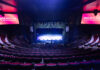
InfoComm 2026 is in the books. The show drew 28,132 verified attendees and 807 exhibitors, according to AVIXA. That is slightly below 2025’s more than 31,000 attendees. However, a broader look at the past five years tells a clearer story: InfoComm has settled into life as a roughly 30,000-attendee show.
One number stands out. AVIXA reported that 37% of this year’s verified attendees were end users. That figure is up from 2025. For a show that started as a trade channel event, that shift matters.
The technology on the floor reflected where the industry is heading. Specifically, it pointed toward simpler control, maturing display markets, and the move to software-first. Here is what caught our attention.
E Ink Goes Big
E Ink made its InfoComm debut this year, and the booth was worth the stop. The company showed multiple color ePaper platforms, including E Ink Marquee, Spectra 6, Kaleido 3, and Prism 3. A 75-inch tiled Spectra 6 display was a centerpiece of the exhibit.
ePaper is not a new technology. But large-format, full-color ePaper for professional signage is still relatively early. The value proposition is simple: the display consumes power only when the content changes. For lobbies, wayfinding, and corporate communications, that is a meaningful operational advantage. The Kaleido 3 platform supports faster refresh rates and partial updates, which opens up more dynamic use cases without abandoning the low-power architecture.
For facilities and IT managers thinking about digital signage, E Ink is worth watching. It will not replace every LED wall. However, it offers a genuinely different option for environments where always-on brightness is not required.
Control Gets More Interesting
Two companies on the floor signaled the same shift: the AV control market is moving away from proprietary ecosystems.
Biamp introduced Workplace Control, a new control platform that brings together intelligent controllers, touch interfaces, and room management into a unified system. The platform targets enterprise-scale deployments and integrates with Biamp’s existing Tesira and Parlé product families. It represents Biamp’s clearest statement yet that control is now a core part of its business, not an add-on.
Meanwhile, Visionary Solutions took a different angle. The company introduced We-Cosystem, built on the open-source Node-RED platform. The pitch is interoperability: instead of locking customers into a vendor-controlled framework, We-Cosystem lets users tap into existing code and integrate across a wider range of technologies. For IT managers who have spent years untangling proprietary system dependencies, that argument lands.
Both approaches solve the same underlying problem. Managing AV systems at enterprise scale requires control infrastructure that works the way IT infrastructure works: visible, manageable, and not held hostage to a single vendor.
Wireless Dante Arrives
Aurora Multimedia announced a new architecture that brings Dante and AES67 audio networking over Wi-Fi. According to Aurora, no company has previously achieved this with a full microphone and speaker system. The RXT-4DW SmartSpeak earned a Best of Show nomination at this year’s show.
Dante, developed by Audinate, has become the standard for professional networked audio over wired Ethernet. Extending that capability to enterprise Wi-Fi infrastructure is a significant step. It opens possibilities for flexible deployments that wired-only architectures simply cannot support. Think conference spaces that need audio distribution without cable runs, or temporary event setups that need to connect to an existing Dante network.
The important caveat is that Wi-Fi audio introduces latency and reliability variables that wired Ethernet does not. Aurora plans to demonstrate the technology in real conditions, and the industry will be watching closely. Nevertheless, the announcement changes the conversation about what a Dante network can look like.
dvLED Grows Up
The direct-view LED display market, known in the industry as dvLED, reached a clear milestone at InfoComm 2026. It is no longer a specialty product. It is a mainstream category, and established display brands want in.
Epson made the most visible statement. The projector company introduced its first dvLED line, the LE-C1 Series, at InfoComm. The lineup uses chip-on-board (COB) technology and comes in 135-inch and 162-inch Full HD models, plus a 135-inch 4K model. According to Epson, the LE-C1 is operating system-free, which reduces maintenance and security vulnerabilities. U.S. availability is planned for summer 2026.
Sony pushed further into the category with the Crystal LED UNIFY, a 135-inch all-in-one dvLED display aimed at corporate boardrooms and higher education. The UNIFY ships as five pre-assembled panels and a control unit. Two people can complete installation in approximately one hour, with no electrical work required. Sony expects to price the UNIFY at $55,000, well below comparable modular configurations. Availability is planned for early 2027.
Planar introduced the Cobra Series, powered by two proprietary technologies: EverPixel and TruMicro. EverPixel incorporates pixel-level redundancy directly into the display, meaning the panel can maintain image quality even if individual pixels fail. TruMicro uses LEDs as small as 20 micrometers to approach true MicroLED performance. The Cobra Series is available in 0.6, 0.7, 0.9, and 1.2 mm pixel pitches, targeting premium indoor applications. Planar CEO Sidney Rittenberg described the Cobra Series as the industry’s first ultra-fine pitch LED platform with pixel-level redundancy.
Taken together, these announcements tell a clear story. The dvLED market has matured to the point where a projector company, a consumer electronics giant, and a display specialist are each making their own bet on the category. Competition is increasing, prices are dropping, and all-in-one options are replacing the complex modular configurations that required a specialist to install and calibrate.
What It Means for You
InfoComm 2026 was not a single-theme show. However, a consistent direction ran through the technology on the floor: the industry is removing friction.
Wireless Dante removes the cable. All-in-one dvLED removes the specialized installer. Open control platforms remove the proprietary lock-in. E Ink removes the power draw. Biamp Workplace removes the reactive support model and replaces it with proactive management.
For IT and facilities managers, these developments mean that AV is getting closer to the way the rest of enterprise technology works. Systems are becoming more manageable, more visible, and less dependent on specialized knowledge to operate. That is a meaningful shift, and InfoComm 2026 made it clear that the industry intends to keep moving in that direction.
We have video from the show floor covering many of these products and conversations. Check AVNation.tv for the full coverage.

Tim Albright is the founder of AVNation and is the driving force behind the AVNation network. He carries the InfoComm CTS, a B.S. from Greenville College and is pursuing an M.S. in Mass Communications from Southern Illinois University at Edwardsville. When not steering the AVNation ship, Tim has spent his career designing systems for churches both large and small, Fortune 500 companies, and education facilities.
- Tim Albright

- Tim Albright

- Tim Albright
- Tim Albright