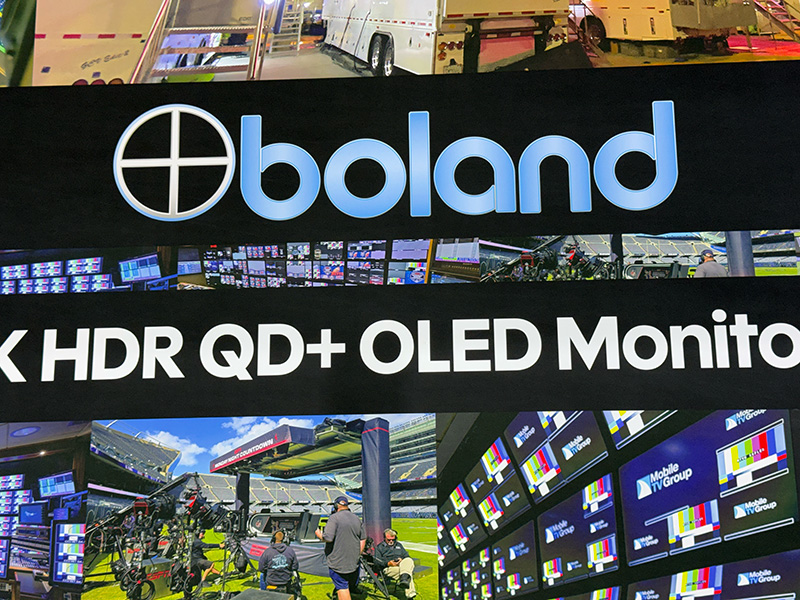
Boland Communications says it will be the first monitor manufacturer to ship a working ST 2110 display. The company confirmed the milestone at IBC 2026, where it holds Stand 12.C57 at the RAI Amsterdam.
The industry has chased ST 2110 for roughly a decade. The standard promised more flexible, IP-based production than traditional SDI plants could offer. Mike Boland, president of Boland Communications, said the promise took years to turn into working hardware.
“It’s probably a working system now,” Boland said of ST 2110 broadly. Even so, he said, it remains costlier than SDI. Boland estimates 2110 gear still runs roughly 50% more than comparable SDI equipment.
That cost gap matters for IT and AV decision-makers weighing an IP migration. Boland said other monitor manufacturers have promised 2110 displays over the last two years. None of them are shipping yet, he said. Boland Communications expects to close that gap first, with units reaching customers this fall.
Cameras adopted ST 2110 quickly, Boland said. Monitors and other edge devices lagged behind. That gap is starting to close. Boland’s new option targets exactly that lagging category.
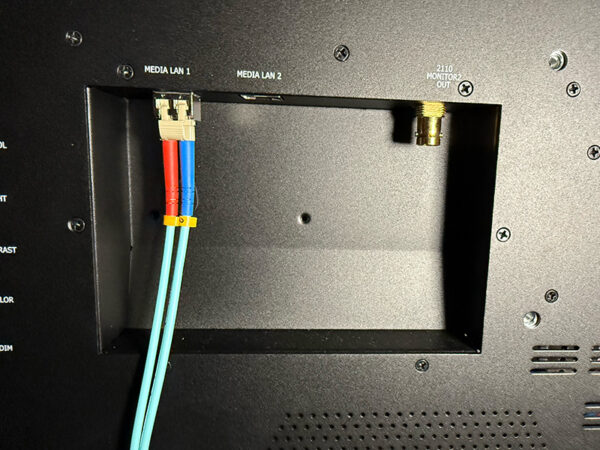
The company’s ST 2110 input option debuts on the QD4K32HDR10-Opt 2110 monitor. A single 25GbE SFP interface handles the connection, using fiber or RJ45 through an SFP28 module. One connection can deliver UHD video to up to two monitors. That design also supports ST 2022-7, which routes redundant video streams over separate network paths.
For facilities building out monitor walls, the option removes a common cost driver. Traditional IP setups need external ST 2110-to-SDI gateways, and those gateways add switch ports, cabling and rack space. Boland’s integrated approach cuts that hardware out entirely.
Boland pointed to another advantage beyond cost. A 2110 system reports detailed status information across the network. If a camera or monitor goes dark, a control room operator can diagnose the failure remotely. That operator no longer needs to physically track down a blown breaker.
Redundancy also improves under 2110, Boland said. Most 2110 systems now ship with backup network layers. Those layers let video switch seamlessly if part of the network fails. That reliability matters most during live events, when a dropped signal has no second chance.
The status reporting goes deeper than a single dark screen. A 2110 controller can track video formats, audio channel counts and delivery status across every connected device at once. So a control room can pinpoint exactly which source stopped delivering. Nobody has to manually check each monitor and camera in turn. That level of visibility becomes more valuable as facilities add more sources and more displays to a single production.
Boland Communications built the new option around a module slot. Newer monitors in the lineup include that slot already. Older units in the company’s existing line do not. Boland said the company won’t retrofit those older monitors as a standard practice, though a mechanical upgrade is technically possible. Most customers, he said, will move to 2110 through new monitor purchases rather than field upgrades.
That detail carries real budget implications. Facilities planning a 2110 transition should factor in new hardware costs. It won’t be a simple software or card swap on existing displays.
Boland’s full 4K monitor lineup, spanning 16 inches to 65 inches, will offer the 2110 option going forward. The lineup keeps native 3840×2160 resolution across every size.
Beyond the 2110 announcement, Boland Communications is introducing two other monitor lines at IBC this year. The first pairs quantum dot and OLED panel technology inside a new QD-OLED series. The second is a 55-inch super-narrow-bezel monitor built for tiled video wall installations.
Boland said the narrow-bezel design has challenged manufacturers for years, since thinner bezels tend to crack under normal handling. The company said it found a panel supplier able to hold that thinner profile without sacrificing durability.
Supply matters more than it might seem, Boland said. Broadcast monitor volume is tiny next to medical and consumer display production. As a result, Boland Communications relies on quality sorting from major panel manufacturers to secure blemish-free panels at broadcast-grade standards.
Calibration also got an upgrade this year. Boland Communications adopted new calibration technology from a UK-based vendor. The goal, Boland said, is letting customers mount a monitor and leave it untouched for years. That consistency matters most for productions that split work across multiple countries. Color needs to match across every location involved.
For IT and AV buyers evaluating monitor walls or IP infrastructure upgrades, Boland’s announcements carry a clear signal. ST 2110 monitoring has crossed from promise to product. Pricing still favors SDI in the near term. But the gap looks set to narrow as more manufacturers ship real hardware instead of demos.
See all of AVNation’s IBC 2026 coverage here.

Tim Albright is the founder of AVNation and is the driving force behind the AVNation network. He carries the InfoComm CTS, a B.S. from Greenville College and is pursuing an M.S. in Mass Communications from Southern Illinois University at Edwardsville. When not steering the AVNation ship, Tim has spent his career designing systems for churches both large and small, Fortune 500 companies, and education facilities.
- Tim Albright

- Tim Albright
- Tim Albright
- Tim Albright