InfoComm 2026 brought no shortage of product launches, but AtlasIED focused on something customers continue to ask for: greater flexibility. Rather than introducing isolated hardware updates, the company expanded its commercial audio ecosystem with two complementary additions, a new Atlas+Fyne pendant speaker family and the AZP amplifier series designed for its Atmosphere platform.
Together, the announcements reflect a growing demand for audio systems that are easier to design, deploy, and scale across diverse commercial environments, from corporate offices and education facilities to hospitality venues and retail spaces.
Completing the Speaker Portfolio
AtlasIED used InfoComm 2026 to debut its Atlas+Fyne pendant speaker lineup in North America. The range includes 4-inch, 6-inch, and 8-inch models, along with an 8-inch high-ceiling version and an 8-inch subwoofer.

The addition fills an important gap in the company’s premium loudspeaker offerings, giving designers more options for open-ceiling environments while maintaining consistency with AtlasIED’s existing ceiling and surface-mount products.
“We just launched the line here in North America, so we have a four, a six, an eight-inch, an eight-inch high-ceiling model, as well as an eight-inch subwoofer,” said Joey Palkowitch. “They’re really rounding out the Atlas+Fyne lineup… bringing the full portfolio to us.”
Pendant speakers have become increasingly common in commercial AV projects, particularly where exposed ceilings are part of the architectural design. Beyond aesthetics, they also help integrators deliver more consistent coverage in spaces that traditional ceiling speakers cannot easily address.
AtlasIED says its new pendant family incorporates the company’s proprietary IsoFlare point-source technology, designed to improve audio performance for both on-axis and off-axis listening positions.
According to Palkowitch, the high-ceiling models can provide coverage in spaces reaching approximately 40 feet, making them suitable for larger commercial environments that require fewer loudspeakers while maintaining intelligibility.
A Different Approach to Amplifier Design
While the new speaker lineup broadens AtlasIED’s hardware portfolio, the company’s new AZP amplifier series may represent the more significant architectural update.
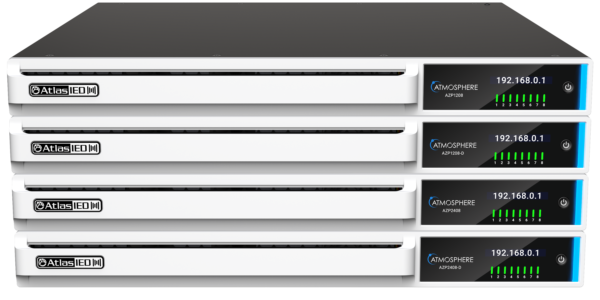
The amplifiers expand the Atmosphere ecosystem, joining the existing AZM processors and AZMP products with integrated amplification. Available in both 150-watt and 300-watt configurations, the new 1RU amplifiers are offered in Dante and non-Dante versions and include cloud connectivity through Atmosphere Cloud.
The defining feature, however, is AtlasIED’s software-defined PowerShare technology.
Rather than assigning fixed amplifier output to individual channels, the system allows installers to allocate available power where it is actually needed.
“So ours is software definable,” Palkowitch explained. “We have either a 600-watt module or a 1,200-watt module, and what you can do is define that within five-watt increments based upon the power that you need, by channel.”
That level of granularity changes how available amplifier power can be distributed across an installation. Instead of oversizing hardware to accommodate a handful of high-demand zones, designers can dedicate more power to one channel while allocating smaller amounts elsewhere.
“You could dedicate the whole 600 or 1,200 watts to one channel, or divide that up into your specific zones,” Palkowitch said. “If you need a heavier zone and then smaller zones, you can do that, or any combination in between, all in that one box.”
For integrators, that flexibility can simplify amplifier selection while reducing the need for multiple dedicated units across different applications.
Designed to Fit Existing Workflows
Interoperability has become a major consideration for commercial AV projects, particularly as organizations continue adopting mixed ecosystems rather than relying on a single manufacturer.
AtlasIED addressed that directly by designing the AZP series around an open API architecture.
The amplifiers integrate with the company’s Atmosphere platform but are not limited to it, allowing deployment in broader control environments.
“We have an open API architecture, so even if it’s not with Atmosphere, we play nice with everyone,” Palkowitch said.
That openness, combined with cloud management capabilities and Dante availability, positions the amplifiers for installations where flexibility is just as important as raw output power.
Flexibility as a Design Strategy
Both product announcements share a common theme: giving system designers more options without increasing system complexity.
The expanded speaker lineup allows integrators to maintain consistent audio quality across different mounting styles and ceiling conditions. At the same time, software-defined amplification gives designers finer control over how power is distributed throughout an installation.
As commercial AV projects continue to emphasize scalability, remote management, and integration across multiple technology platforms, products that reduce hardware constraints while increasing deployment flexibility are becoming increasingly valuable.
Rather than focusing solely on higher power or additional features, AtlasIED’s InfoComm 2026 announcements highlight a broader shift toward configurable infrastructure, allowing integrators to tailor systems to the needs of each space instead of designing around the limitations of the hardware.
For organizations planning new installations or modernizing existing audio systems, that flexibility may ultimately prove to be the most important feature of all.
- AVNation Staff

- AVNation Staff
- AVNation Staff

- AVNation Staff